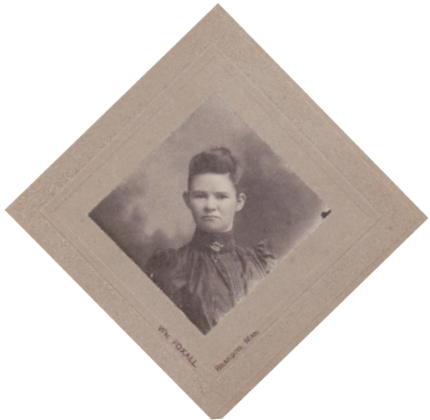
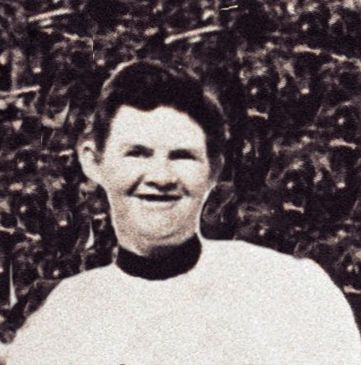
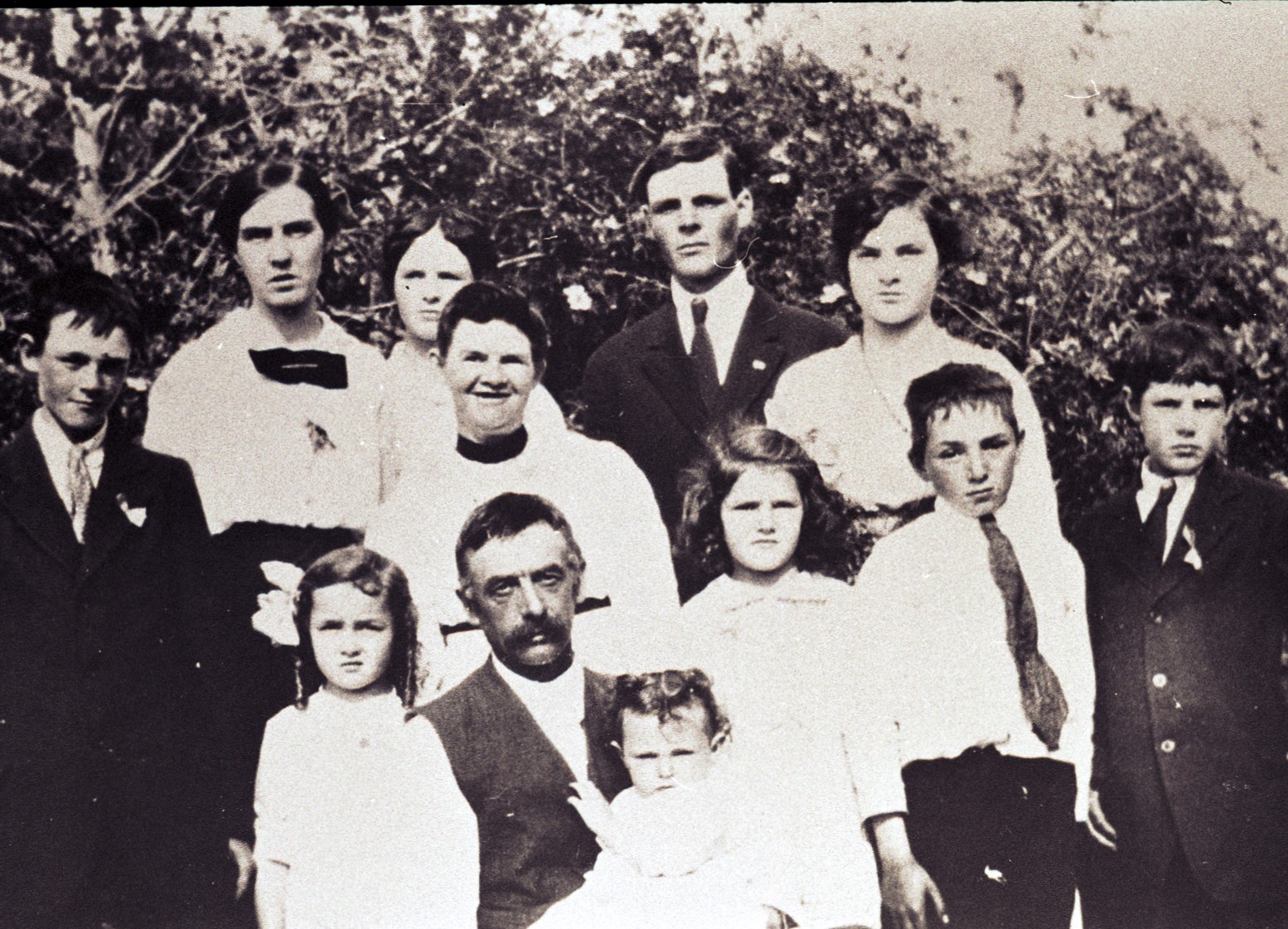
Emilie
Joan Smale was born December 4, 1869 in the working class district of
Hampstead, in London. Her father had been a coppersmith, but had died
two
months earlier in October, leaving her mother, already with one older
child, to
support herself and two children. She would eventually need assistance
from the
“Poor Law” of the time which would break up the family unit and cause
the
emigration to Canada of 10 year old Emilie. We
have
been able to determine that her parents were John Smale, b Mar 20,.1844
and
Mary Anne Hedges, b about 1838. They were married Oct 26,
1862 at the
Whitechapel church in Middlesex co. John was a coppersmith. Their first
child,
Annie Elizabeth was born September 12, 1863, and we find no more
information
until John dies Oct 1, 1869; apparently of a violent death and,
according to
the death certificate, he was of “Unsound Mind”. Emilie
Joan Smale was born December 4 of that same year (1869). In January of
the
following year, Mary Anne, now a widow, proceeds to register Emilie and
to also have her
baptised at Mary Anne's own church; Whitechapel in Middlesex. April
2,
1871 was census day, and we find Annie Elizabeth Smale (7) and Emilie
Joan
Smale (1) in the home of one George Hedges. We know that George Hedges
is a
sibling of Mary Anne. Since there is no sign of Mary Anne, we
wondered if she had died by this time but could find no sign of a death
registered. We should mention that there are many Smale females, and
many Mary
Annes and one must sort which ones might be the correct ones. We looked
for DOB
circa 1838, an association with Whitechapel, birth location of
Hampstead, and
she is known to be a widow. We found these criteria in the 1871 census
at the
home of a Mr and Mrs Latham, a solicitor. Mary Ann is noted to be a
servant and
a nurse. Later,
in
October 5, 1871, we find that Anne Smale, 34, Anne Smale, 8, and Emily
Smale 2
were all admitted to the St Pancras Workhouse. They each had various
lengths of
stay and is a possible indication that they were all stricken with some
sickness or other. They may also have applied for help under the “Poor
Law”,
since Mary Anne was now pregnant with an illegitimate child (Hugh Mark
Smale who
was born in the Workhouse later that year) and the Poor Law
may have
required that the entire family present to the Workhouse. Emily was
eventually
sent out to “School”, Anne (8) to another ward and Ann (34) was sent to
“out”.
When Mary Anne gave birth to Hugh Mark Smale in November of 1871, that
child was
also committed to the workhouse, and died there after 10 months. By
these
findings, we know that Mary Anne was alive at least until Emilie was
approximately 3 years old. At this point, Emilie was probably living in
the
workhouse and Mary Anne, although possibly still living, having a
declining
contact with both of her children. Their future was almost certainly
decided by
various institutions from then on, including Emilie’s candidacy for
emigration
under the Home Children program, and her eventual involvement with Miss
Maria
Rye. Emilie’s
story as remembered by her daughter Catherine McIlquham begins as a
girl of nine
years old in a London orphanage……..” She was treated kindly by the
matron who
was reluctant to allow her to leave the orphanage to the care of her
foster
parents. However she was persuaded and Emilie left in the
care of her new
parents who would take her with them to Canada and settle in
"Northern Manitoba". ……….”At 14 she ran away from this home to live in Brandon. She was eventually befriended by a doctor who made her his assistant. She was starved for reading material and read medical books, knowledge which was to benefit her large family in later years. Her recipe for cough syrup was legendary, but it was not handed down to her children. She is remembered as being deeply religious and was proud of her refusal as a child to bring beer to her employers…………." The
story
above was apparently related to Emilie’s children, but has
become a type
of Folklore which apparently is based loosely on real happenings; the
differences probably the result of retellings, coupled with an initial
embarrassment felt by all “Home children” . Most
of
the Home children were sponsored by philanthropic organizations such as
Barnardos (being the largest). Others were Miss Rye, Miss McPherson,
and many
more. We find our first trace of Emilie's life as a “Home Child” in the
records of
Miss Rye. In 2016, we have found what we consider to be her record in .the home records of Miss Maria Rye. Miss Rye was one of the original proponents of the practice of emigrating British subjects to the colonies , and during the 1870's had received much negative publicity for the practice. The negativity subsided when she began using paupers and orphans as her subjects. This was favourably received by the Canadian government because it provided the new colony with low cost labourers for the farms and households; and overlooked by the British government because it rid them of a significant social problem. Miss Rye was one of a handful of organizations who brought children into Canada by the boatload, staged them at her facility at Niagara on the Lake, and moved them to individual placements. Miss Rye probably had honourable intentions towards the children when she stipulated that they were to " be treated as one of the family’ or ‘To sit at the same table’ ". One
of the workhouses that supplied Miss Rye with candidates was St
Pancras;
the same place that Emily had been placed by her Mother at age 2. In
1880,
Miss Rye's records contain an Emily Smaile, 10 years old as having
stayed at
Miss Rye's staging home at Niagara on the Lake. She is said to have
immigrated
in 1880 on the ship “Peruvian”, departing January 29, but other records
show her as having been transported by the ship "Sarmatian" in a June
20 arrival. According to
Maria Rye’s
hand-written accounting, three groups of children (mostly but not
entirely
girls) were brought into Canada during 1880. There were 98 children in
total,
and she billed the Canadian Government $2 for each in her invoice
submitted in
November 1880, just
after the last load
had been catalogued. We have not yet discovered sailing
records
for Emilie’s voyage on the Peruvian, but researchers following
other passengers on that same voyage have reported that the ship may
have been forced to dock in Halifax probably due to ice conditions at
Quebec, and Halifax passenger lists in these years are known to be
unavailable. Researchers
specializing in "Maria Rye" archival material have identified that
Emilie was probably indentured in 1880 to a farm family in
Homer, Ontario;
Joseph and Anna Lampman. If so, by 1881 census, another
"Servant" also from the Rye home named Sarah Berry, who was
approximately the same age was the only such person present. This note
from that archivist
............."The
1880 Annual Report of Miss Rye’s Emigration Home for Destitute Little
Girls
reports, at entry no 4 “E.S., aged 10, father dead and stepmother very
cruel.
To Mrs L., Farmer, Homer, Ontario. Bound. Mrs L. has had another of our
girls”................." Also
this note which might explain Emilie's reluctance to serve
beer and which
may have resulted in an "unsatisfactory" rating and a quick re-posting
".....It seems that the Rye girls had pledged to abstain from
alcohol
because several of the letters published in the annual reports make
mention of
the fact that the child concerned had stuck by their pledge to abstain
–…….” We
have
found no “Emily Smale” or similar name in the Canadian 1881 census, but
there
is some indication that she had been “adopted” by John and Elizabeth
Kinney prior to
census time. John Kinney and Elizabeth Pollock were married in Ontario in 1869 in the Welland area. In the 1881 census, a family named Kenie (Spelling variation has changed from Kinney, to Kenie, and also Kenney) is entered, again at Welland, showing John, Elizabeth, Andrew, Emily, William, and David. There are specific birth records for each child except Emily, supporting speculation that this girl is Emilie Smale. At
this time, the Kinney family lived at Welland, Ontario, which
places their home within about ten miles of the Maria Rye Home at
Niagara on the Lake. (This is also the case with the Lampman home at
Homer). The
Kinney family later moved to Manitoba and homesteaded near Chater, in
the
Brandon area. "Municipal
Memories"
is a 1984 history of the RM of Cornwallis. A family history
of
the Kinneys was written for this publication by a then-elderly
wife of one of the Kinney boys and states in part “.........
…………………………..” [Note]
The
fate
of the “adopted” child is not mentioned further. In
1887.
The Manitoba archives record that a child by the name of Annie
Elizabeth Smale
Cascaden was born on January 13 in the RM of Cornwallis. The Mother is
recorded as Emily Joan Smale,
(who would have turned 17 a month
earlier). On
the
child’s Birth Certificate, the Father is named as John Cascaden and the
delivery was assisted by a midwife named Mrs Kinney, This baby was more
than a
month old when registered on February 18, 1887 There
is
no trace of a John Cascaden (of the appropriate age) in
Manitoba's 1881,
or 1891 Census', but a Homesteader named John Windle Cascaden
proved a
title in 1886 for land in Manitoba on Sec.18, Twp 9, Range 16 which is
near to
the village of Chater, Manitoba . Under the terms
of the
land
grant, he would have been required to live at that location for several
years and must have done so because he was named as postmaster at the
local settlement of Aweme. By 1891, however, the
census finds Johnie Windle Cascaden back in Ontario,
single and age 34, living with his aging parents. Emilie’s child, Annie Elizabeth Smale Cascaden is not mentioned in any other Manitoba Archives and her records remain unsealed in the Archives, which should indicate a lack of (Manitoba) adoption. In the absence of a corresponding Death Report, a private adoption is probable. It should
be noted that in the adoption discussion for both Annie Elizabeth, and
Emilie
herself; adoption procedures in Canada had not yet been well
formalized. For example, it was not
until 1893 that the Act for the Cruelty to and Better Protection of
Children
was enacted, and this allowed creation of the Children’s Aid Society
and the development of better
procedures for the adoption of children. The
child's name (Annie Elizabeth) is an exact match for Emilie's own
Sister.
Emilie and her sister may have lived together for some time as children
since
she was very familiar with the name. .By
1891
in the Manitoba census Emily was recorded as living at Kemnay (a small
town on the opposite side of Brandon from the previously mentioned
Chater) with the Pooles,
and was married that same October to Arthur
Durston. (She was recorded as a “Spinster”)
She later related to her children an expectation that after their
marriage
Arthur would be reunited with his children (Tom and Annie) whom she
wanted to
raise. However these children remained in Ontario living with the
Whitmores
while Arthur and Emilie had their own family. In
1983,
the RM of Whitehead published a centennial history book and invited
families to
present their family histories. The Arthur Durston family would have
been
written by surviving Durston children; both Arthur and Emilie having
been dead
for many years. The book states in part that "..........He (Arthur) came
to the Kemnay district around 1885.
(it would have been 1891) He and his wife, the
former Ann Ainsley (we
now know her name to have been Amesbury), had two
children, Tom and Annie. After
Ann died, the children were raised by the Kinneys of
Kemnay...." We know that Tom and Annie were
actually raised by
the Whitmores in Ontario and Manitoba, but mention of the Kinney family
is yet another
example of the imprint that the "Kinneys" had made on Emilie. She
was
married in Brandon, Manitoba on October 10, 1891 to Arthur Durston.
Children
were Edith Merle, William Arthur, Winnifred Maude, Nellie Ruby born
while they
were living at Kemnay. In
1899,
the family moved to Griswold, Manitoba where the remaining eight
children were
born. Their home was on NE1/4 of 5-9-22W1. These children were Anthony
John,
Albert Charles, Frank Henry, Dora Emily Martha, Catherine Ruth, Jessie
Rose,
Lucy, and Lily. Lucy and Lily died as infants and are buried on this
property After
the
death of Arthur in 1929, Emilie remained on the farm as her children
left to
pursue their various endeavours. Albert was the last to leave in 1937
when he
married Bertha Donogh from a neighbouring farm and moved to another
nearby.. In
1943, she
moved into the village of Griswold until she needed steady assistance.
She died
in a personal care home in Brandon on April 25, 1949 and is buried at
Griswold,
Manitoba, Canada
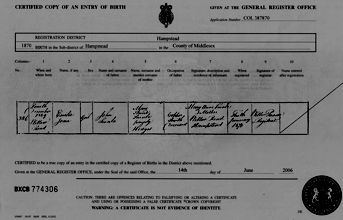 The Birth certificate of Emilie Joan Smale 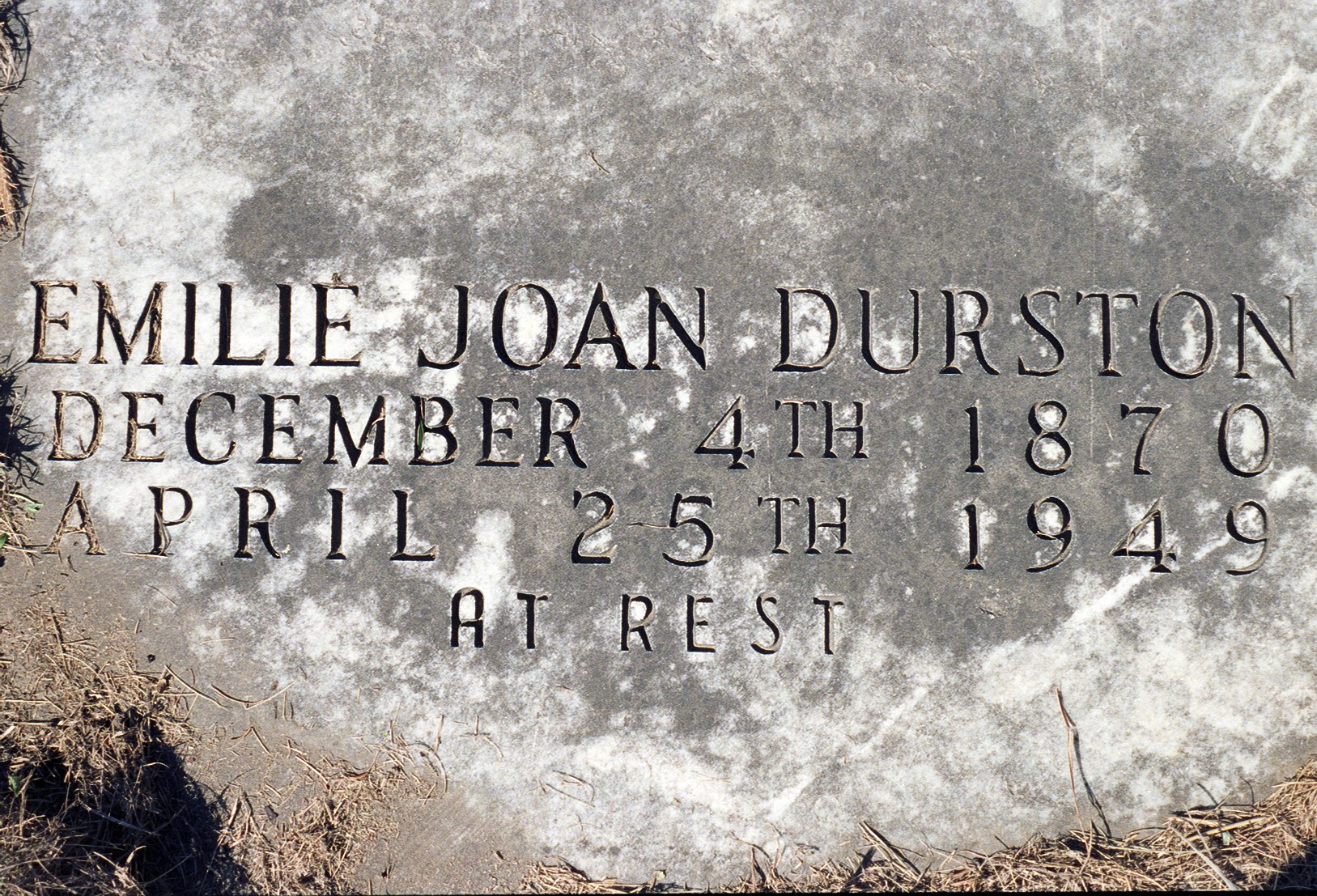 The grave of Emilie Joan Smale Durston at Griswold (Manitoba) Cemetery DOB on the monument should be 1869 |
||||